1/13/2017

Ageism: What It Is and How to Fight It

As a member of not only the Gerontological Society of America, but also the APTA's Academy of Geriatric Physical Therapy, I feel that I have a unique outlook on the aging process. At my current job, the majority of my patients are considered to be "older adults," with many of them pushing 100 years old. As an active component of the GSA and AGPT, I feel that I have a different perspective on my patient population than many of my contemporaries do. Without connection to professional societies, it is easy to develop poor clinical habits, but the worst habit of all to adapt is to discriminate against someone for their age. The level of discrimination that I am talking about is subtle and pervasive in our health care system. This isn't an out right "We don't serve your kind here" but an almost unnoticeable adjustment in clinical care for our older adults. This veil of discrimination is part of a larger problem called ageism, and as health care professionals it is easy to fall into line with the social attitudes many people have about aging. But as healthcare providers, we should also act as change agents for our patients who are older adults to change not only their attitudes about aging, but also to convey to our co-workers that ageist tendencies are unethical  and downright illegal even in the simplest of forms.

Here are a few questions to ask yourself to make sure you aren't harboring ageist tendencies:

  1. Am I adjusting my treatment parameters because of their impairments, or because of their age? I have heard it time and time again from coworkers in multiple settings about how old someone is and how they need a "break" because of it. I'm sorry, but that patient is here to work. If they are not capable of participating in therapy at this time than you either need to adjust what you are doing or consider an alternate plan of care that is appropriate for their deficits, not their age. 
  2. Are you avoiding more difficult activities because of the patient's age, or because they truly aren't ready for it physically? I have heard clinicians across the spectrum complain and whine that cannot do a certain activity with a patient because of their age, but that is ageism. Now, saying that someone is not ready to do an activity because of their muscle weakness, or endurance limitations is much more solid and objective clinical reasoning. 
  3. Are you using age as an excuse for not rendering services? There is also the idea that if someone is older, debilitated, and has a care-giver that they do not need to learn how to do for themselves... and this is WRONG. Whether the patient opts to do an activity with or without the care taker is their prerogative, but your prerogative is to at least give them the option to be able to do it on their own. This decreases caregiver burden/burnout and empowers your patient with an increased level of independence, however small the task may be. 


Should we consider age as a factor when evaluating our patients? Sure. But it should be used as only a single piece in the complex puzzle that is the care of our patients. Age should not serve as a giant stamp on our patient's foreheads, warning all who come into contact with them that they can't handle physical therapy. Here are a few ways that it is respectful and clinically relevant to our practice as physical therapists to include age in our plan of care:
  1. Aging comes with certain comorbidities that should be addressed, but remember that many of those comorbidities (osteoporosis, osteoarthritis, etc) can also occur in much younger populations if all conditions are right. You don't get these issues because you are old, you get them because body processes aren't working appropriately. This doesn't mean that you aren't more likely to develop them as you age, but it also doesn't mean that you will automatically have them either. 
  2. Older adults could have different values and goals than their younger contemporaries in the clinic, but there is also the possibility that they don't! I have met older adults who can be staunch republicans and in the next bed have a raving democrat for a roommate! Values and goals are relevant to the experiences that the person undergoes as they develop their sense of self. A suffragette will have vastly different ideals that someone who grew up on a plantation in the south. 
  3. Using age to stratify for outcome measures is not only appropriate, but statistically supported. Many of our outcome measures for older adults are stratified by age groups, so it is appropriate to utilize these numbers based on these delineations in order to best identify how our patients compare to healthy individuals. This allows us to promote evidence-based practice and goal setting to return our patients to their prior level of function. 
  4. Finally, it is important to celebrate the triumphs of our older adult patients without quantifying the statement by age. When a patient demonstrates a task well, don't say, "well that is pretty good for someone your age" because it is no different than saying "Not bad for a girl." If the second phrase angers you, then the first one should as well. 

Above all, please remember: Being "old" is not a disease. Age is not a clinical impairment. Let's empower our patients instead of stigmatizing them! 

1/09/2017

Protecting Your Profession: Standing Up for Physical Therapy Is the Same Thing as Standing Up for your Patients

Education is perhaps the most powerful tool we have in our arsenal. We use it to help patients understand their condition and the importance of their treatment, but how consistent are we in educating them on our field as a sovereign entity? As a physical therapist, it is easy to forget that not everyone knows what we do or how we relate to other healthcare providers. Occasionally I get a question about our field that I think to myself "Are you kidding me? How dumb can you be?" However, after taking a step back, I realize that not everyone has the exposure to our field as those of us who actually live and breathe the profession. Below are some of the questions/interactions I have had:

"When will you go back to school to get your nursing degree and move up in the world?"

Doctor: Give them a walker.
Me: They aren't safe to use one at home. I am not prescribing one.
Doctor: Well I want them to have one. 
Me: Okay then, you prescribe it. 
Doctor: I need you to write in your note that they are safe to use it. I'm the doctor. 
Me: And I am a Doctor of PT. Now that that is cleared up, back to our issue: they are going to fall with the walker, so if you would like to be liable for the lawsuit, be my guest. 

"Aren't you just a glorified massage therapist? The doctor said all you do is massage?" 

Initially these questions made me angry as I felt personally offended, but now they make me angry because I realize that we still have a long way to educate the general public on our services. So many ailments can be treated with physical therapy and people aren't gaining access to our services simply because they don't know about them.

Not only are we not doing a good job on educating the public, but we are also not doing enough to educate other healthcare professionals on what we do. I still meet OTs that make snide comments that we "go for walks for no reason" and doctors that are shocked we can improve lung perfusion with breathing exercises as I wean patients off of supplemental oxygen. While some comments are made in jest, we should treat them as serious as intentional transgressions against our field's character. If we aggressively treat this issue, then we will be seen as a serious field and the symptom of the pain associated with poorly educated members of society with quickly diminish.

I recommend rehearsing a monologue in order to calmly respond to these prompts. Having your elevator spiel ready at a moment's notice is handy for reacting to these issues. Educating our patients, fellow healthcare workers, and society at large is our greatest weapons for managing these changes in our systems. If people knew just how beneficial and widespread our services are, there would be no question about the necessity of them. We could survive any reform or shifting care paradigm because we would be in demand like never before. It is up to use to ensure the future of our field, and education is our secret weapon.

12/23/2016

Anatomy of a Blog Post: From Abstract Creativity to the Internet

I have been hosting this blog for nearly half a year now, and I have had a few questions about my creative processes, so I figured I would write a post on how to create a post. I resisted the urge to call it "Post-ception" as I didn't want any copyright issues popping up, but corny title aside, I am writing about how I write. I have had a formula that I discovered early on in high school and has carried me through graduate school and beyond. Thankfully for me, it works for both creative and formal writing pieces, so I am sticking to it! Here goes:

  1. It all starts with a single sentence or phrase. It might not be the title, it might not be the thesis, and it might not even be the most poignant part of my post, but it serves as a spark for the flame of creativity. I type it out first, bold it, and keep coming back to it throughout my writing. It keeps me grounded and on-topic. 
  2. I don't write chronologically. To prove my point, this is actually the bullet point that I wrote last. I move throughout the the text, editing as I go and rearranging as I see fit. Usually the paragraph that I write in the last half of my time spent is the first paragraph of my post, which makes sense to me because by then I know the tone of the entire post and can write a more appropriate introduction to set the stage for the drama I create. 
  3. I often write several posts at once. Right now I have 3 windows open for 3 different topics. As I come up with ideas, I realize that an idea I am developing in one post is better off as it's own idea. While this may seem a little scattered, it lets my mind move fluidly and unhindered, allowing the creative juices to spill from my mind and onto the page. 
  4. I listen to music that inspires me and take frequent dance/singing breaks. I have participated in both of these arts and I feel that by letting my mind do what it wants like an ADHD child, I am able to articulate my thoughts more crisply. The soundtrack of Hamilton has been my main inspiration as of late. Sia's new album is another I like to jam to as I type.
  5. I don't always finish in one sitting, but most of the time I do. The times that I do walk away from it and stew are the times when I don't get beyond more than a paragraph. I learned to abandon topics that aren't coming easily to the paper (or word doc) early before I invest a lot of precious time into them. If it isn't flowing from my finger tips, the topic either isn't ready or it isn't made to be. And I am okay with that fact. I don't sit down to write until I have at least a few hours to dedicate to the task. I have been known to sit for hours until 20 page term papers are done. I also wrote my literature review, as well as my thesis for DPT school, in one sitting. This time is of course interspersed with random dance/jam breaks. 
  6. I let ideas sit in my brain for weeks on occasion before setting aside time for the activity of writing it out. I really capitalize on the concept of subconscious processing to allow more ideas to form. The longer I wait, the faster I am able to write. 
  7. I dress for the occasion. If I am writing a professionally invigorating post, I wear business casual. Seeing as this is more of a creative post, I am currently wearing my mermaid yoga pants, a brand new haircut, a punk band shirt, and a single sock. It's odd, but it's working for me currently. 
  8. I edit very minimally. I look at spelling and grammar, clarify confusing statements, and delete duplicate thoughts. I really only make the adjustments my editor requests, as I know that my process helps with a lot of the other issues authors run into.
Creative people are often seen as inherently quirky, and I suppose the way that I approach writing a blog is much the same way. Seeing as Van Gogh chopped off his ear and Darwin married his cousin, I think I am in a pretty good place. If you are looking to understand more habits of creative people, the Huffington Post write a neat article explaining several things that highly creative people do different. It might help explain a lot about your abstract relatives or even give you a few ideas on how to foster your own creative spark! 

12/16/2016

Legacy: It's Not What We Do, but What We Leave Behind

As I turn 26, I am noticing that a lot of people at my age are in a turning point of their life. People are getting married, having children, and starting career paths. Coming from the Millennial Generation, we are often seen as the "me" generation... and for good reason; what with the advent of social media, it is hard to not to be lambasted with images of "look where I vacations" and "look what I am eating" and "look at my accomplishment." People measure success in different ways, however I believe that true success is measured not by what we are doing, but what we leave behind from those efforts. Events such as marriages, having children, or creating a DPT program happen to more than one person, and it is what you do to make this experiences special that create true success.

One example of this is holding titles/offices. Any one can hold a title, but it is what you do with that power that matters. For instance (at the chance of being political here), the title of President. Anyone can be president, but it is what you do with that title that you are measured for your success. History is a documentation of what was left behind, and greatness is determined by those historical artifacts. Think of a president of the United States. Right now. Any president. My guess is that you chose Washington, Jefferson, Lincoln, JKF, FDR, or maybe even Obama. It is also my assumption that the names Filmore, van Buren, and Harrison probably didn't cross your mind. That is because, unlike the former, these individuals didn't leave much of a lasting impact. Now that is not to say that they weren't good at their job, but relative to other POTUSes, these guys weren't exactly political icons. Another difference between these two groups are that the POTUSes that were in power during the greatest times of adversity had the opportunity to engage with and react to the challenges presented to them, thus leaving a memorable legacy.

With the ever-changing landscape of health care reforms, we as physical therapists have the same opportunity to leave a lasting impression on our fellow health care workers. We are presented with unprecedented challenges right now to which we can either respond with strength and passion, or we can wait 20 years to wave an "I Participated" pennant. If we allow ourselves to be defined as what we are doing, such as simply attending PT school, or completing a PT residency, or treating patients, we are only filling half of the puzzle. We must see our actions from the perspectives of future minds who will look at us and see what we left behind. What did we do to create a lasting impact on the field? Simply existing and showing up isn't enough. Anyone can hold an office or say they are "super involved," but unless you have the evidence to back up your claims, people are going to call you on your null hypothesis. We must thirst for change and strive for lasting impacts.

In short, don't make people just look, make them focus. Saying that you held an office is not nearly as impressive as the programs you implemented or the practices you affected. You may have a laundry list of a resume, but that will eventually mean nothing. Resume-building is important, but once you reach a certain level of superiority, people start to look at what you are doing instead of the fact that you have that status. History will forget you if you do only enough to look impressive on paper. To quote the play Hamilton, history has it's eyes on you... so now that it is looking, what are you going to do to make it focus in on you?

12/09/2016

The Genesis of Genius: When McMillan Lectures all Make Sense at Once (Book Review Part 1)

On my flight home from the GSA Annual Scientific Meeting in New Orleans, I picked up a book in the airport, having exhausted my stash of scientific journals that I brought along with me. The title of the book is The Geography of Genius: Lessons from the World's Most Creative Places by Eric Weiner. Weiner is a journalist who is on a mission to determine why "genius flourishes in certain places at specific times" in an effort to essentially find an algorithm for intelligence uprisings. Throughout the book (I am only half way through it at this point), he travels the world to speak with experts, temporaries, and prodigies of the most genius minds in history. His travels take him to Athens to explore the ancient and most profound philosophers, Edinburgh to immerse in the medical and other scientific advancements of Scotland, Hangzhou to bask in the glory days of the Song Dynasty, and many other adventures. He takes an in-depth look not only at the personal lives of individuals who we as a culture now deem as "genius," but also at the political, environmental, and sociocultural dynamics taking place at the time of the uprising of these great minds.

I found this book most interesting because of how I felt it related to the field of physical therapy. While a physical therapist hasn't been deemed an official genius to the greater community of the world (to my knowledge anyway), we have many individuals within our microscopic infrastructure and related-community who would qualify for the title based on their life's works in either the clinics, the research lab, or often times, both. 

Two Mary McMillan Lectures were called to mind thus far in my indulgence reading. The first of which was Alan Jette's 2012 lecture entitled Face Into the Storm. In this lecture, Alan makes several interesting and inspiring points in relation to managing the many challenges that physical therapy was about to face at the time. However, the most pertinent lesson that I internalized from attending the lecture was that the field as a whole must face into the incoming storm and not run away, but rise up to meet the challenges head on.  This pedagogy, according to Weiner's discoveries thus far, is a cesspool for breeding an influx of genius within the field. Many ideas are birthed in the face of adversity. Just as the need for good hand hygiene was the window of opportunity between post autopsy and pre-delivery events in the medical field, limited insurance reimbursement and rapid health care cuts led the way for the inspiration of many community based programs as well as health and wellness initiative for the physical therapy field. 

The second lecture that presented a parallel to my readings was Lynn Synder-Mackler's 2015 lecture entitled Not Eureka. In this 46th lecture, Lynn describes how the greatest moments of discovery are not necessarily known immediately and are not often a big event initially. In act, the greatest discoveries and moments of genius tend to occur with a quite moment followed by  a solemn "well, that's funny." A subtle change or shift in the winds can result in needing to adjust your trajectory to a solution, often leading you down the novel and rarely-traveled path of ingenuity. Many scientific discoveries are not considered major until years of discussion, attempts to discredit them, and other new theories begin to support this existing paradigm (think spherical earth theory). 

The two most important ideals established in this work of literature are the following: 
  1. Genius is a Process. That is right, with a capital P. It often doesn't happen all at once and the efforts of the individual are often not rewarded until years after the death of the individual (which might be why we have no certified PT geniuses as we are still a relatively infantile field). Also, a major part of the process of genius is a collective cultural response to the works of said individual stating the status of "genius", as society as a whole often has to see the worth and relevance to the ideas. 
  2. Genius is often a unique response to a unique challenge which is necessary to continue to drive forward progress, survival, and stability for the human race. The reason I say human race is that we don't often describe animals as geniuses, and the ones we do are somehow able to successfully mimic human qualities anyway (such as Suda the painting elephant or KoKo the gorilla) therefore, genius seems to be an explicitly human or human-esque title. 

I highly recommend this book. It is witty, information, and has enough fun side tangents to keep this piece of non-fiction from being too dry and boring. It is also a good reminder that when the going gets tough, the tough better get going to the library because genius is only a train of thought away. 

12/03/2016

Beyond APTA Involvement: Is there worth in membership to groups outside our clique?

I recently got home from a whirl wind trip to the Gerontological Society of America's (GSA) 2016 Annual Scientific Meeting in New Orleans, Louisiana. While I was only present in the city for a measly 36 hours due to the constrictions of having starting a new job (PTO what???), it was still an unprecedented, highly inspiration 36 hours which has led to the culmination of several new blog post ideas as well as many new networking relationships and activities to keep me busy throughout at least the first half of 2017. Each conference has a theme, and this year the theme was "New Lens on Aging." The thought behind this theme, which was carefully and most appropriately selected by our outgoing chair, Nancy Morrow-Howell, was to take a new look at how we view the science behind aging. However, I feel that this theme had a subtext to it that wasn't expected by myself, or perhaps any of the conference goers.

I feel that as healthcare, academic, and research professionals, we all wear our unique set of lenses when it comes to how we view aging. My physical therapy-shaded glasses will be different than the filter provided in the lens of that of an MD, public health official, or even that of the patient/client we are all simultaneously assisting. In order to be successful in our endeavors to aid and assist those who are aging, each lens is a small part of the greater image that is aging, and without the entire team, we fail in even the best intentions for this diverse population.

I have been a member of GSA for 3 years now. I initially joined as a way to gain access to their extensive database of interdisciplinary research as I was embarking on my primary thesis at the time for my Doctor of Physical Therapy degree. What I discovered in this organization was beyond just a data blitz. It was also mentor-ship, friendship, and collaboration with individuals from around the world which has shaped me into the young researcher and clinician that I am today in the field of human aging. Surprisingly though, most of these individuals who has inspired me within the realm of GSA were not physical therapists. I have found that through my involvement with other groups, I have connected to people who are also involved in APTA who I might not have met otherwise through the APTA alone.

Interdisciplinary collaboration: this recent buzz word is a new trend in medicine and medical management of our patients. The paradigm has shifted to include opinions from all sorts of professionals within the health care system including even spiritual care staff. Within GSA world, this interdisciplinary conversation takes place among clinicians and academics, grad students and field experts, social workers and doctors, and on and on and on. These relationships foster the growth for improving translation of knowledge from the lab to the patient experience.

As for the main stem of my thesis in this post, the answer is "it depends" on whether or not membership in groups outside of the APTA is worthwhile. I feel that it depends on the group. Someone else who isn't as driven by this pedagogy might not find the same value.

Nevertheless, I implore you to look into at least one professional association outside of the APTA in order to broaden your scope of practice and gain new insight into the world you love (be it geriatrics, neuro, sports, ortho. or whatever else). You might even have some fun and meet some neat people along the way.

9/28/2016

47th Mary McMillan Lecture: Inspiring Lasting Change or A Social Media Blip?

At the APTA NEXT 2016 conference, Dr. Carole B. Lewis, PT, DPT, PhD, GCS, GTC, MSG, FAPTA gave the 47th Mary McMillan Lecture titled "Our Future Selves: Unprecedented Opportunities" in Nashville, TN. I was not in attendance, but once the event was over, I was bombarded on social media about the importance of care for our aging population. My initial reaction was joy. "Finally," I thought, "People are getting what I have been talking about for the past 3 years!" But that elation was quickly turned into cynicism. The people advocating for change the most were people whom I had grown to know as having a general distaste for the geriatric population; some of whom had downright ageist viewpoints and had complained about having to work with a geriatric patient instead of a young, recovering athlete in the clinic. Suddenly, I felt catapulted into the Twilight Zone and waited for what seemed like ages for the Tower of Terror to suddenly jerk downwards until everyone's feet were back on solid ground and minds were returned to their rightful place.

You may ask yourself, what is wrong with a renewed focus on geriatrics? How could a sudden interest in one of the most difficult populations to obtain appropriate care for be a bad thing? After all, there is strength in numbers right? Yes and no. I am thrilled that this topic was brought to the forefront of our minds. Its important and relevant to all issues related to healthcare. My issue is not with the message which was flawlessly presented, but with the reaction of the PT masses to the topic (or to any major announcement really). There are two types of change agents: those that garner short term results and those that garner long term results. Most of the positive results are incurred short term in a reaction like this, which is not not the solution that we so dearly need right now.

Now, let us dissent....

I'm not saying you can't be interested in or can't explore other realms of PT. For example, I'm not the biggest fan of pediatrics, but if a worthwhile petition to improve service provision to the population comes my way, of course I will sign it. Will I go out of my way to make sure I hunt down every other PT I know to sign it? Mostly likely not. And that is okay. If we all reacted this way to everything, then nothing would be special and no one would be specialized, which is an absolute necessity in our field. 

This is similar to the high school student who is aiming for Ivy League schools and signs up for as many extra-curriculars as possible. They don't really like what they are doing, but they see it as a way to get to the next step of what they want to do. The goals in the PT world can be anything from an executive position in the APTA to the glory of all those likes, re-tweets, and social media attention. What ever the underlying motive, if its not an altruistic one, then that individual is sure to crash and burn eventually.

Growing up, my parents had a saying: "If it isn't fun anymore, then don't do it." While this is an over-simplified mantra, and there are a lot of things that aren't fun but should still be done (dentists appointments, paying taxes, etc), there is a lot of merit to it and it has lead me to the successful and happy person I am today. I tried pee-wee basketball, hated it, and never went back. When dance became too stressful (Dance Moms is real, y'all!), I switched studios and eventually stopped to focus on school. When Academic Decathlon turned out to be just as ridiculous as it sounds, I left. When I had to quit a job because of an insufferable co-worker,  I found another position that I was even more thrilled to participate in. These may sound like a lot of instances in which I quit, but I don't see it that way. For a short period of time, all these things gave me joy and pride. But then, as circumstances changed, so did my happiness. It was then time to pick up a new hobby or adventure to make sure that I was taking care of myself.


This is why when I see someone tackling issues that I know they actually don't care about, and they are just getting caught up in the hype of "should do" instead of "want to do." I pity that individual. I am a huge proponent of "If I don't want to, then I won't." I can't be made to do anything I don't want or need to do. If it isn't necessary to my survival and/or job, and it's not interesting, then I won't participate in it. Pressure from peers, or even my own mother, can't even change my mind. I feel like this ends up making my convictions stronger in the end because all my actions are backed with the passion to fuel them to success.

I also witnessed a similar instance occur after the previous Mary McMillan lecture. Students whom I had known for years were suddenly interested in research and calling themselves "clinician scientists" when just the previous day they were complaining about how having to complete a research project to graduate from their program was a colossal waste of time. (For reference, our program only required one project and several students in the program - myself included - were able to complete several successfully in that time, so I have no patience for the "waste of time" complaint.) It was equally as amusing as it was annoying watching people get all riled up with the rest of social media and the conference goers only to see them slowly drift back into their old habits.


Now I can relate to the whole research thing. When I found out my senior year of undergrad that I would have to conduct a research study to fulfill my honors capstone requirement, I was pissed. I hated research. It was boring and monotonous and I wasn't interested. However, after creating my own study, carrying it out, and presenting the results at a research symposium, I was hooked and hungry for more. While I consider myself dedicated to the scientific method, this relationship has only been official for the last 4-5 years. I am no means an expert, but in that time I have conducted several other studies and have demonstrated that I am dedicated to this lifestyle.

Look, no one is doubting the fact that research seems cold and heartless. Research doesn't care about your feelings or woes. It simply exists as a venue for information discovery and dissemination. The scientific method is a well-oiled machine with no room for your bullshit. At the end of the day, the results are the results and your job is to figure out how best to present and connect them to the existing paradigms we currently operate under. It's an entire beast in its own right and it is not to be messed with. I don't think that people really understood that when they all jumped on the bandwagon in the summer of 2015.

Now to be perfectly clear, this poor sustainability of action resulting from the lecture topics is not the fault of any of the lecturers, the conference committee, or the APTA as an institution. Their purpose is to showcase their passion and message to the crowd at the conference, in hopes of inspiring lasting change and social engagement. My qualm is with the people who take the message, run with it, get tired, and put it down to rest in some ditch in the middle of nowhere.

While NEXT and CSM are great for information dissemination and networking, gone are the days of deep discussion and face-to-face contact in the advent of social media. Using social media to convey a message about something as important as the renewed focus on geriatric care or clinical research results in these vitally critical topics being handled as superficially as the relationships garnered on social media platforms. Sure we get the instant gratification of a topic trending on Twitter, but do we actually see lasting policy change to benefit clinicians and their patients? Not commonly. The facade of "I care about everything" is then shattered and debunked as humanly impossible. Moreover, the dreams of individuals who actually care about these things are often left deferred and no real change is garnered to ensure to future of physical therapy.

In the advent of social media, people get all jazzed up for a few days/weeks/months and then nothing comes of it or people forget about it as the next big thing comes around. Case in point: the ALS ice bucket challenge. People got super into campaigning for raising money for the foundation and then they forgot about it. This was evident through the number of posts I see currently with the link to the research that was actually conducted with the money raised paired with "I forgot about this" statements.

If you are going to make a lasting change, great! But if you pledge, push, and advocate for it, then make sure you follow through. One of my biggest pet peeves is to see someone get excited about something that I am excited about, only to see them back off and change their mind a week later after the conference hype has settled down. The best way to make a lasting change is to align it with interests you already have established. For instance, as a sports PT, you can still advocate for geriatric physical therapy, but that lasting change will come if you actually carry that attitude over to your clinical practice. Examples of this include volunteering as a medical professional for the Senior Olympics or holding a movement/health screen for seniors interested in starting a sports recreation program. When you extend your advocacy efforts too far beyond your prevailing interests, you often don't have enough support or resources to continue to foster growth in that area.

In conclusion, your time is valuable. Don't waste it on an endeavor because you feel like someone is expecting you to or it is what your peers are doing. The only conviction that matters is your own. I don't care if everyone else thinks that something is the best idea ever; if you are not convinced, then its time to figure out why so you can direct your attention to something that reaps lasting benefits for not only yourself, but also your patients.

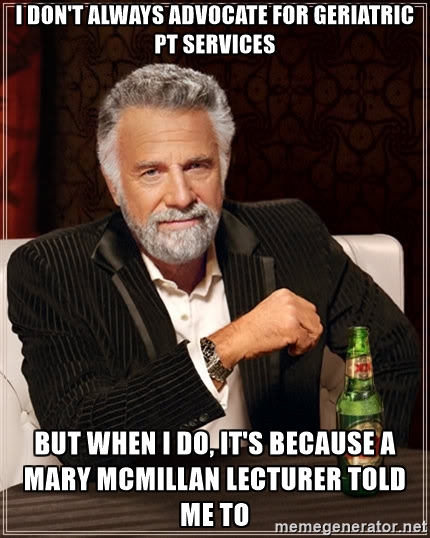
All memes were created by Heidi Moyer using Meme Generator. 

Featured Post

Why I Introduce Myself as Heidi, Doctor of Physical Therapy

A really hot topic in today's field continues to be the use of "doctor" as a descriptor for those of us that hold a DPT degree...